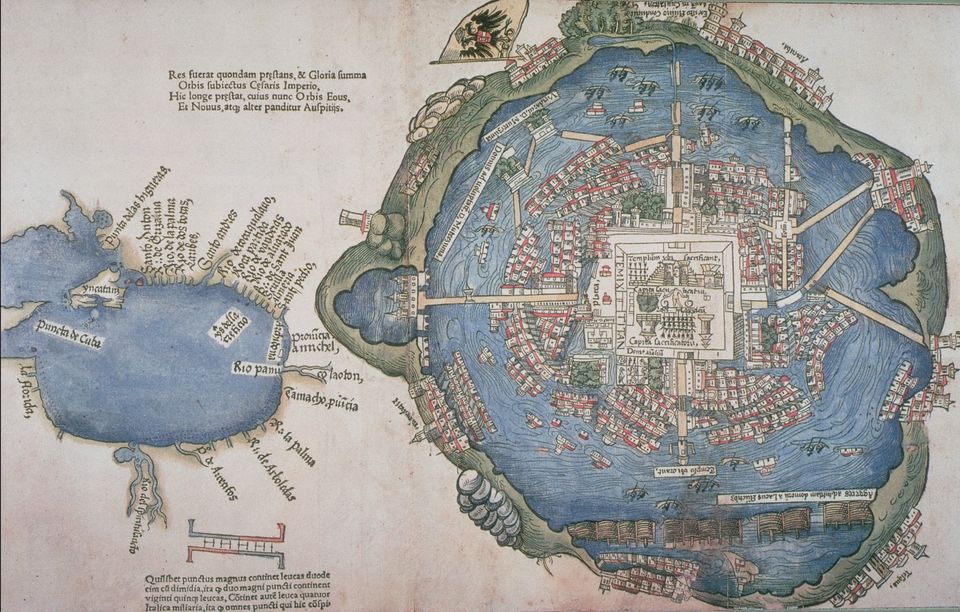
 Nuremberg Map (also known as the Cortés Map), 1524, Friedrich Peypus – Foto: wikimedia, public domain
Speculation Through Critical Cartography
Mapping Pasts in the Service of Alternative FuturesThis essay argues that maps are critical tools capable of supporting or supplanting speculative urban futures. Rather than mere renderings of reality, maps embody, reflect, and reinforce spatial imaginaries. Although frequently deployed to legitimize hegemonic visions, maps can also foster civic deliberation and challenge existing power structures. Using the case of Mexico City, we examine how maps were originally used to invisibilize water in the service of power, and how these imaginaries are now being reappropriated to establish alternative water futures. We claim that contemporary speculative practices built on historically-informed collective imagination can challenge old hegemonies and provide new ideas of what might be.
Johanna Hoffman is an urbanist working in the space between design, planning, fiction, and futures. She specializes in using speculative futures tools to enhance collaborative capacities in urban planning and policy development. She is a founder of the research and action institute Design for Adaptation and holds an MLA in landscape architecture and environmental planning from UC Berkeley.
Diane E. Davis is Professor of Regional Development and Urbanism and former Chair of the Department of Urban Planning and Design at Harvard’s Graduate School of Design (GSD). She also is the director of the Mexican Cities Initiative at the GSD, Co-Director of the CIFAR program, Humanity’s Urban Future, and faculty chair of the committee on Mexico at the David Rockefeller Center for Latin American Studies at Harvard.